
Communication must be HOT. That’s Honest, Open, and Two-Way.
Dan Oswald
Oral communication is the first method that humans developed. In primary oral cultures, people relay information solely through speech, meaning, everything is said and heard. I could say that the practice was particularly more expressive and elaborate, which although may require more time and effort, is a practice that would never get outdated or out of use. But as curious and innovative humans in nature, we are open to exploring different mediums in sharing ideas. And thus, we’ve learned to bring speech to life by representing them through words. Literate culture paved its way to being the most popular and most used method in today’s era, continually extending its use with the birth of the print industry. While modern and considered as ‘state-of-the-art’, it also falls short on some situations where communication is deemed ineffective without the help of speech. And therefore, Ong’s idea on them illuminating each other proves its point.
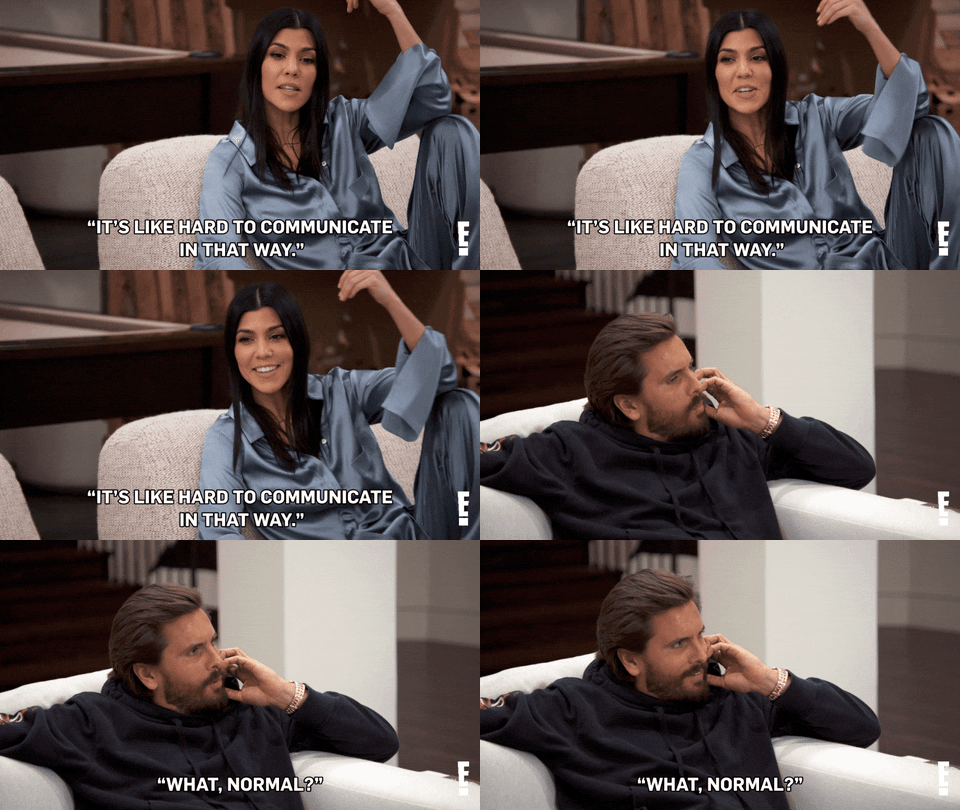
To communicate is to interact and to understand. Which implicates that communication cannot be a one-way process (Ong, 1982). There should definitely be an idea that coexists between two (or more) conscious minds, allowing each to indulge in more ideas and giving way for feedback. Effective communication differs itself from media where intersubjectivity is neglected that makes human connection unsuccessful.
Going back to the discussion of communication cultures; technology is playing a huge role in the progress of communication methods. As mentioned, print culture has emerged from the popularity of literate culture. Print is the ‘media’ model of communication which mainly consists of informational texts that are catered to a general, if not imaginary, audience. It is a kind of communication platform wherein the sender is present prior to the presence of the receiver, and basically no feedback is being anticipated. Comparing to oral culture, this goes to show that the chirographic medium only involves a one-way current, and therefore the information should be as easy as possible to be absorbed and understood by the future receivers.
Communication is a thorough process; it involves skill in relaying and understanding through various models (oral and written) in order to achieve it effectively. With that said, communication should not be limited to only speech or in its written form. Oral culture is not out, it should not be reduced, rather it should be correlated with modern culture.
 Angelica's Blogs